The conversation surrounding water quality continues and takes a quick step back to follow up on our tech tip from two weeks ago. And next Friday, as a belated Christmas Gift, we’ll cover blending water with non-RO sources. We know it was on your list for Santa …
PROBLEM: Last week’s Tech Tip was about how to implement acid injection — a follow-up to our WK 47 segment on alkalinity. For those of you who have struggled with which direction to take your acid injection strategy, we hope that info provided you with some clarity. We said we’d cover nutrient imbalances and occasional oddball water quality concerns here in WK 51, but we felt it was more important to touch on the general issue of elevated EC first.
NICK’S TIP: This week we’ll follow up to our WK 48 piece on water quality, specifically on soluble salts. As a quick refresher, soluble salts or EC (electrical conductivity) is the measure of how many ions (like Ca2+, K+, Mg2+, NO3–, NH4+ etc.) are in solution in your water. The higher the concentration of ions dissolved in your water, the higher the EC value.
Quick sidebar: A question Nick has gotten frequently these past few weeks has been on units of measurement. So …
• While it’s fairly easy to convert EC units from one to another, mS/cm (MilliSiemens per centimeter) is the one to use.
• This is the most common metric used in research and on crop culture sheets from different plant genetics providers.
• Use of mS/cm or µS/cm only requires an occasional shift of a decimal place to interpret the value reported, depending upon what your EC meter reports. In contrast, if you use an EC meter that reports in ppm (parts per million), you need to know whether your meter uses a 0.5 or 0.7 conversion factor in order to translate the reading into mS/cm.
If your raw water’s EC is naturally high (much above ~1.0 mS/cm), this can cause issues for your crops over time. This is especially true if you rarely leach with clear water, provide constant liquid feed (apply fertilizer every time you water), maintain a low leaching fraction (limited water you apply runs out the bottom of the pot), and/or have salt-sensitive species like New Guinea or interspecific impatiens on the bench. If your water tends to run on the “salty” side, here are a few considerations for how to reduce it.
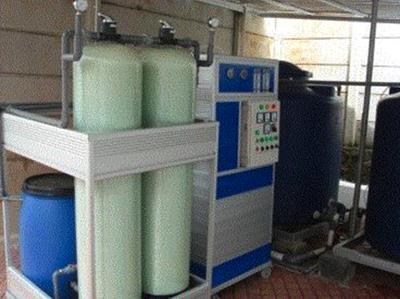
Install a Reverse Osmosis (RO) System
This type of system forces water through a semipermeable membrane that allows water molecules to pass through but not larger molecules like salts (plus other impurities). While this is undoubtedly the most expensive option for reducing EC in your water, it is the most consistent in terms of how much it can cut down EC year-round. Keep in mind, this system needs to be maintained regularly, and additional infrastructure must be installed to blend RO water with your primary source.
• For example, if your raw water EC is 1.5 mS/cm, you could do a 50/50 blend with RO water to bring it down to 0.75 mS/cm. This will allow you to minimize EC-related disorders and reduce the cost of running your RO system.
• You should not irrigate or apply fertilizer solution with pure RO water, or you may run into low-alkalinity issues and crash your substrate pH because you’ve removed all of the water’s natural buffering capacity.
Also, be conscious of the overall impact of using a RO system. It takes about 4 to 5 gallons of water to produce 1 gallon of RO water.