We field this geranium challenge from growers to identify and correct just about every year: Iron and manganese toxicity.
PROBLEM: A couple of weeks ago, you may have seen the YouTube short that Dr. Will Healy did on “The Geranium 10-week problem.” If you didn’t, and you have large container geraniums in your greenhouse right now, be sure to check it out HERE. And read on for more details.
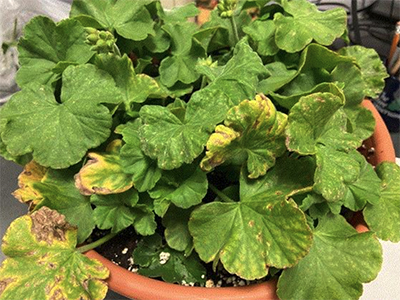
NICK’S TIP: It’s critical to prevent iron and manganese (Fe and Mn, respectively) toxicity in geraniums, rather than react when symptoms start to appear on lower leaves.
What Does Fe/Mn Toxicity Look Like?
Symptoms vary slightly across classes of geraniums (Pelargonium x hortorum, P. peltatum, P. domesticum and interspecific hybrids) and even among cultivars within a series, but they always appear on the oldest leaves first.
Symptoms often start as chlorosis (yellowing) along the leaf margin or chlorotic speckles from the centers out to the edges of leaves. Chlorosis advances across affected leaves over time.
As symptom severity increases, the yellowed leaf margin and/or speckles in the middle of leaves will start to look burned (necrotic) and develop into dark-colored necrotic splotches. These spots eventually coalesce and grow until they cover most of the leaf.
If the disorder advances further, entire leaves will become necrotic and fall off, and symptoms will start to appear on the next oldest healthy tissue as older leaves become heavily compromised.
Why Does Fe/Mn Toxicity Happen?
On rare occasions, Fe/Mn toxicity can result from overapplication of micronutrients (e.g. someone messed up their fertilizer calculations). However, the vast majority of the time, this disorder occurs when the growing media pH gets too low, specifically due to depletion of the growing media’s lime buffer (powdered dolomitic limestone that’s mixed in during the manufacturing process). Plants in the Pelargonium genus hail from areas with soils with naturally abundant limestone content, so they evolved to be especially good at acidifying the soil around them, to mine mineral nutrients like phosphorus, Fe and Mn that would otherwise be unavailable to roots due to elevated pH. Check out this nice fact sheet from Purdue Extension on soil pH and how it affects nutrient availability for more info. But the abbreviated explanation is this: Low soil pH makes it so easy for plants to absorb Fe and Mn ions that they can’t not take them up.
Plants also can’t excrete waste and excess nutrients the way animals do, so they push surplus Fe and Mn ions into the vacuoles of leaf cells (membrane-bound “sacs” in the middle of cells) to “get rid of them.” As it does in many living things, accumulation of these heavy metals disrupts cell function and eventually causes damage to tissues with accumulated Fe/Mn ions.
What Causes Lime Buffer Burnout?
As Will mentioned in his video, longer-term geranium crops (large container programs) naturally deplete their lime buffer simply because geraniums are experts at acidifying their growing media!
However, there are a number of factors that can hasten this process. The most common causes we see are:
Overuse of acidic fertilizers. Ammonia- and urea-based fertilizers like 20-10-20, 21-5-20, and 20-20-20 are acidic and “acid special” formulations like 21-7-7 are highly acidic. Depending on the amount of alkalinity (buffer capacity) in your water (see this past tip on alkalinity HERE for more info), frequent use of these types of fertilizers can drive soil pH down too low over time.
Overcorrection of alkalinity via acid injection. Growers who inject acid to reduce alkalinity in their irrigation water need to monitor water quality regularly. If water quality changes suddenly and alkalinity drops, the amount of acid that has been injected previously is too high. This often removes most of or all the buffering capacity in your irrigation water and causes your raw irrigation water to be slightly acidic at baseline. Add an acidic fertilizer formulation to the mix and the pH of your growing media will crash quickly. In this situation, even a nitrate-based fertilizer isn’t basic enough to correct the pH of the fertilizer solution, and the net result is still acidic.
Insufficient lime buffer at manufacture. Commercially produced soilless mixes have a dolomitic lime charge added when they are created. This helps keep the pH in a range that is optimal for plant growth and resists changes in pH due to acid reactions that occur in the root zone. Sometimes, manufacturers experience equipment malfunctions, and the mixing line does not add enough lime to the media as it is manufactured. This can happen but is not often the cause of Fe/Mn toxicity in geraniums. When it does occur, toxicity symptoms often show up much earlier than “10 weeks” after transplant, and widespread symptoms are readily apparent across other high-pH-loving crops like marigolds and pentas, as well.
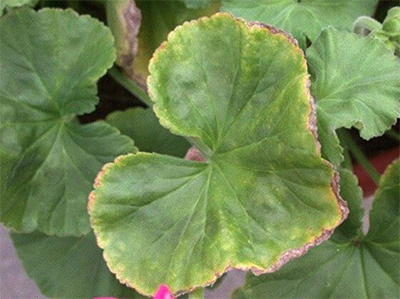
The best way to avoid this disorder in your geraniums is to regularly monitor the pH of your growing media. A pour-thru (see my quick how-to video HERE) on a few pots or hanging baskets each week is a quick way to make sure soil pH is in an appropriate range for geraniums.
• Target soil pH of 5.8 or higher for ivy and interspecific geraniums to keep them out of trouble.
• Target a minimum soil pH closer to 6.0 for zonal geraniums, as they are less tolerant of lower soil pH than ivy and interspecific geraniums.
• If you start to see early indicators of Fe/Mn toxicity, act quickly. Once damage is done, affected leaves will not recover. Corrective measures often take a few days to slow symptom progression, so the longer you wait, the worse the problem will get. To start, check soil pH ASAP and figure out how strongly you need to react:
• If soil pH is about 5.6 to 5.7, symptoms are mild, and only one or two “indicator” cultivars are showing symptoms, you can often correct soil pH with a simple switch to a nitrate-based fertilizer like a Cal-Mag (like 15-5-15).
• If you already use a nitrate-based fertilizer but you inject acid to your irrigation water, reduce your acid injection concentration slightly.
• If you don’t inject acid into your irrigation water and already use a nitrate-based fertilizer, apply a periodic drench of potassium bicarbonate to your geraniums. These types of products are water-soluble and easy to apply through an injector, but they only aid in minor/temporary pH correction.
• For larger containers, you can spread a tablespoon or so of dolomitic limestone powder onto the top of growing media or larger containers and gently water it in. If pots are on drip irrigation, you will need to do this via hose and breaker or overhead boom to “activate” the lime and get it down into the soil column. Drippers will not put out enough volume to adequately move that limestone material down to where it needs to be.
Alternatively, you can apply a limestone slurry or flowable lime agent (such as CalOx pH) that contains multiple forms of lime (fast-acting and long-lasting) to correct soil pH and help keep it stable over a longer period. Continue to monitor soil pH and reapply as needed.