Usually our weekly tips are courtesy of Ball Seed Technical Services troubleshooter Nick Flax, but this week Dr. Josh Henry is taking over with some special tech training on a specific plant growth regulator: Benzyladenine.
What is benzyladenine? Benzyladenine (BA) is a synthetic cytokinin that disrupts apical dominance, stimulating lateral bud break and improving branching. Commercially available as Configure, BA is applied as a foliar spray used to promote lateral branching and, in some species, enhance flowering. Uniform spray coverage and thorough canopy penetration are essential for effective results since BA has limited translocation within the plant.
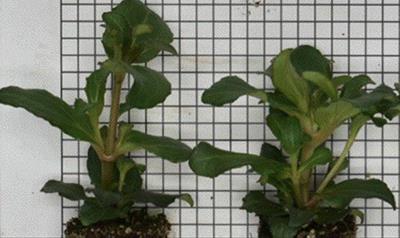
Non-pinched liner (left) with a more upright growth habit compared to a liner treated with BA (right).
BA Uses: Many herbaceous perennials, including Echinacea and Hosta, have demonstrated strong responses to BA sprays with two- to 10-fold increases in branching compared to non-treated plants. Research on numerous annuals and perennials has documented improved branching without phytotoxicity with proper use. However, response to BA is highly dependent on the species and cultivar, so one variety may respond well while another may not. Some studies report that BA can delay flowering but ultimately increase flower number when applied early in the crop cycle. In certain crops, such as Schlumbergera (Christmas cactus), BA increases flower bud formation when applied at floral initiation. It can also boost offset production in crops like Sempervivum (hens and chicks). Check out the Fine Americas Configure Product Information and University Trial Results for an in-depth review of species-specific rates and responses.
Application: BA is most effective when applied to young, actively-growing plants that have developed multiple lateral buds. One application after transplant establishment is often sufficient, though two lower-rate sprays spaced two weeks apart can also work well. Applications can be made in the liner stage and again after transplant. Typical rates range from 200 to 600 ppm, but it’s best to start conservatively (100–200 ppm) when using BA on new species or cultivars. Use adequate spray volume to thoroughly reach the stems and axillary buds. Maintain spray solution pH between 5.0 and 8.0 and apply within 24 hours of mixing.
Tank Mixing: University of Kentucky trials reported enhanced branching and improved control when BA was tank-mixed with indole-3-butyric acid (IBA) during propagation. Research from Virginia Tech also reported successful tank mixes of BA with gibberellic acid (GA) biosynthesis inhibitors such as paclobutrazol, while other studies reported success when combining BA with ethephon or daminozide. However, while these tank mixes can be effective, they do not provide truly synergistic effects.
Risks: Overapplication or use on sensitive varieties can lead to leaf spotting, chlorosis or distortion. Crops under stress from low fertility, drought or temperature extremes are less likely to respond well. To maximize uptake and minimize risk, apply early in the morning or under low light/high humidity conditions to extend leaf wetness. Always read and follow the label to ensure products are compatible with your intended application and crop to prevent potential antagonisms or phytotoxicity.