This week Nick Flax is kicking off a two-part tip on downy mildew, a problem the Technical Services team helps growers deal with every year. This week, he’ll share ID and life cycle info. Next week will be all about management strategies and useful resources.
PROBLEM: It’s that time of year again! When the weather starts to turn and warm temperatures begin to spike, growers start to send us photos of plants with suspicious symptoms and ask, “Does that look like downy mildew to you?” Thankfully, many of these have been false alarms so far this spring, but it’s only a matter of time until our disease diagnostic lab at Ball starts to confirm DM cases around North America.
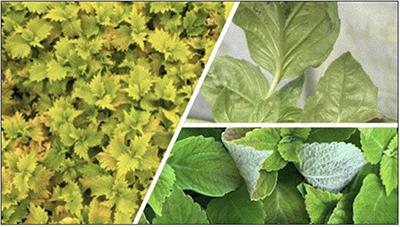
NICK’S TIP: As a group, downy mildew-causing pathogens are difficult to detect, they strike fast and can quickly develop resistance to fungicides. Exclusion is not possible in most cases, so it is critical to scout regularly for disease symptoms and signs, understand their life cycles, and establish a culture of prevention to avoid costly losses for you and your customers.
Downy Mildew Identification
Disease symptoms vary from crop to crop, but mottling and mild chlorosis on lower leaves are often the earliest visible symptoms. It is easy to mistake this for any number of mineral nutrient deficiencies, so many growers overlook this early warning sign. Oftentimes, the whiteish or grayish dusty spore clusters on the undersides of infected leaves are what we find when scouting our crops. Unfortunately, by the time these symptoms and signs appear, it’s often too late for the crop. As disease progresses, infected areas become necrotic and affected foliage dies.
• In most cases, downy mildews will cause total collapse of plants they infect.
• While some DMs don’t spread aggressively in a systemic manner through their host, they quickly produce additional spores and reinfect other healthy parts of the plant.
Understand the Downy Mildew Life Cycle
When a grower finds DM in their greenhouse, the first question we often get is, “where did it come from?” Part of the challenge with this group of pathogens is… it depends. The term “downy mildew” encompasses multiple genera of organisms and many species within each genus. While there are similarities among many of these organisms, nuances between each dictate where the initial infection occurs and how to best prevent it. For practical purposes, DMs can produce two types of spores:
Sporangia — the dusty-colored “fuzzies” found on the undersides of leaves of infected plants.
• Though they’re often short-lived and can remain viable for hours to days at a time after they are produced (depending on the species), these spores spread via splashing water and can travel long distances on air currents to infect a new host.
• These spores can reinfect healthy parts of their host plant and spread to adjacent, susceptible crops in your greenhouse.
• All DMs reproduce via this asexual spore life stage.
Oospores — often called “resting spores” or “survival spores,” these durable structures can survive in soil, plant debris and water for years at a time.
• When a susceptible host grows or is planted nearby, these spores can infect through the rootzone or by blowing or splashing up from the ground onto lower leaves of the plant.
• Notably, Plasmopara destructor (formerly P. obducens), which causes impatiens downy mildew (IDM), produces oospores, but not all DMs do.
Many DMs survive in the landscape in soil or debris of infected plants from the previous season. When weather conditions are right, spores germinate and infect bedding plants or closely related native species and weeds. These infected plants produce more sporangia that spread further via wind to find new hosts.
• In the greenhouse, these wind-blown sporangia often serve as the initial source of infection in a given season.
• Some DMs can be seedborne, so it is important to get your seed from reliable sources and know the inherent risks of DM in certain crops before you grow them.
• It's impossible to keep these tiny assassins from slipping in through your greenhouse vents, so prevention is a must.