Intumescence is a fairly common issue this time of year. Here’s some details on this disorder.
PROBLEM: Cold and cloudy weather means many greenhouses have been buttoned up tight for the last few weeks. While we’ve often talked with growers about moisture- and humidity-related issues since Week 1, an old familiar “friend” that occurs in early spring under similar conditions has come back to visit North American growers this week. It’s bumpy and weird looking and evokes goosebumps if you run your hand across it just right: it’s intumescence!
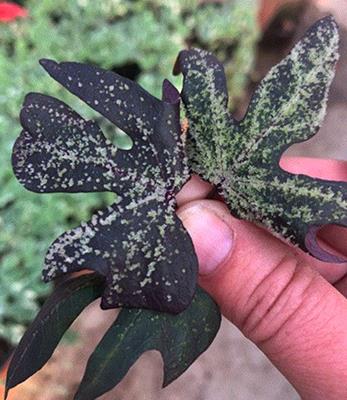
NICK’S TIP: While occurrences have been linked to a lack of UVB radiation in greenhouse environments during crop production, it’s still not 100% clear why intumescence occurs. However, this disorder results in some concerning symptoms — especially if you aren’t familiar with how to identify it — and growers are often (and understandably) freaked out when they see it for the first time.
Early symptoms often present as rows of bumps or “pustules” along stems, leaf petioles and midribs. Depending on the crop, lesions may range in color from light to dark and sometimes translucent.
When symptoms are severe, lesions can coalesce into masses and oftentimes appear more broadly across the undersides and even on tops of leaves. As lesions mature, they often become darker in color and eventually take on a corky color and eventually become blackish brown as the tissue senesces.
Intumescence is known to affect several crops, but sweet potato vine (Ipomoea batatas) and Black-eyed Susan vine (Thunbergia alata) are two of the most frequently reported. Tomato (Solanum lycopersicum) and Cuphea spp. are also more common victims of this disorder.
Lesions on thunbergia, cuphea and tomato are most often circular or spherical, while lesions on ipomoea are often more angular or geometric in appearance when viewed under magnification.
At first glance, many growers mistake intumescence lesions as insect eggs, fungal spots or crown gall (Agrobacterium tumefaciens). However, if you see symptoms in your greenhouse on one or two of the crops mentioned in this week’s tip and not on anything else it’s most likely just intumescence.
Some varieties are more prone to intumescence, so make note of any varieties that seem to be more affected than others in your operation. If customers express concerns or any of your crops are unsaleable due to unsightly symptoms, it may be wise to avoid growing these varieties in the future.
While this is certainly an unsightly disorder, it won’t negatively impact overall development and health of the crop. Affected plant parts don't recover (lesions don’t disappear), but new growth tends to be less and less affected as spring progresses. If you receive young plants that have intumescence symptoms, don’t worry — they can be grown on to maturity without issue. Some selective cleanup and removal of affected leaves before plants hit retail may be advisable, but be sure to wait until new growth is symptom-free before doing so.
Check out these awesome e-GRO Alerts on intumescence of ipomoea and thunbergia for some great photos and more details.