This week we continue our ongoing discussions about specific plant growth regulators and how they work. This time, we’re diving into ethephon.
PROBLEM: Ethephon is a versatile plant growth regulator (PGR) used to improve branching, abort flowers and flower buds, delay flowering, enhance fruit ripening and manage plant height in a wide range of floriculture crops. When applied, ethephon breaks down into ethylene, a plant hormone that triggers physiological responses like increased lateral shoot development and flower inhibition. Proper chemical mixing, application timing and environmental conditions at the time of application are essential for optimizing ethephon applications while minimizing risks like phytotoxicity and delayed flowering.
JOSH’S TIP: Ethephon (2-chloroethylphosphonic acid) is a synthetic plant growth regulator that when absorbed by the plant releases the plant hormone ethylene. Ethylene is a naturally occurring hormone that influences a wide range of physiological processes. Ethephon applications can result in reduced apical dominance, increased lateral branching, delayed flowering and shortened internodes. These effects make ethephon a valuable tool for growth regulation throughout the production cycle.
Uses: Ethephon can be used to suppress internode elongation, keeping plants compact through a different mode of action than gibberellic acid inhibitors. Applications to improve lateral branching are typically made one to two weeks after transplant to provide sufficient time for rooting prior to application because ethephon can delay or inhibit rooting. Ethephon can be used to abort flowers and flower buds, keeping plants vegetative and allowing them to bulk up prior to flowering.
In general, the last application of ethephon should be made six to eight weeks prior to the target sale date to provide sufficient time for flowering. For sensitive crops like petunias, calibrachoa and geraniums, growers should trial rates and timing to avoid unintended delays in flowering or excessive stunting.
Mixing: Ethephon is most stable at low pH with a target final solution pH between 4.5 and 5.0. Spray solution pH values greater than 6.1 render ethephon inactive. Growers should routinely test their water and neutralize excess alkalinity with acid or other conditioning agents. Commercial formulations are available with either 3.9% or 21.7% ethephon, so double-check the formulation to ensure correct mixing. Common spray rates range from 250 to 500 ppm with 2 quarts applied per 100 sq. ft.
Spray Applications: Ethephon degrades quickly in the spray tank and must be applied within 4 hours of mixing. Ethephon is absorbed primarily through the foliage and is not translocated throughout the plant, so uniform spray coverage is essential. Ethephon is moderately well absorbed by the plant over the course of 12 to 16 hours after application. It is also important to note that ethephon has one of the longest restricted-entry intervals (REI) of any PGR – 48 hours. Crop-specific recommendations can be found in the GrowerTalks ANNUAL and PERENNIAL PGR guides. Trial applications are recommended before full-scale use. Remember, always read and follow the label to ensure products are compatible with your intended application.
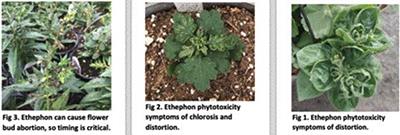
Environmental Considerations: Ethephon efficacy and crop safety is highly dependent on environmental conditions and crop stress at the time of application. Ethephon is most effective at temperatures between 57F and 73F (14 to 22C), and under high humidity where foliar absorption is maximized. Applying ethephon in the morning can help reduce evaporation and improve uptake. Applications made under water or nutrient stress or during hot, dry or high-light conditions can increase the risk of phytotoxicity symptoms like lower leaf chlorosis (yellowing), leaf distortion or stunted growth.