Our technical specialist, Dr. Josh Henry, weighs in this week to discuss a topic that’s becoming more and more common but definitely requires close attention and careful selection (of crops and active ingredients): PGR liner dips.
PROBLEM: Chemical plant growth regulators (PGRs) are typically applied as a foliar spray, sprench or substrate drench. But liner dips, also known as liner soaks, can be an efficient and effective application method for liners just prior to transplant. NOTE: Only certain PGRs can be applied as a liner dip, so always read and follow the product label as directed.
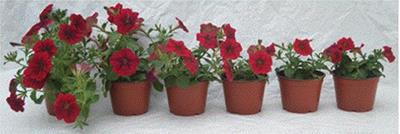
(above) Effects of paclobutrazol liner drips on petunia six weeks after transplant. Rates shown here from left to right were 0, 4,8,16,32 and 64 ppm with a two-minute soak duration.
JOSH’S TIP: Liner dips involve briefly submerging the root zone of a liner tray into a PGR solution, which requires less total PGR due to the smaller volume of substrate found in a liner compared to the finished container.
Why Liner Dips? When compared with sprays, sprenches and drenches, liner dips offer unique benefits. They provide uniform application across trays, they use active ingredient effectively, and they are especially effective for managing vigorous varieties before transplant, particularly in mixed containers. Only PGRs with root activity, such as paclobutrazol, uniconazole, flurprimidol and ancymidol, are effective as liner dips, and not all products with these ingredients are labeled for this use. Always read the product label to verify whether it is approved for liner dips.
Best Practices for Application. Achieving reliable results with liner dips depends on several key details during application.
- Liners should be uniformly moist but not saturated or excessively dry at the time of application, as this ensures predictable PGR absorption and minimizes variability across trays. Water liners the afternoon prior to treatment and apply dips the following morning for best consistency.
- The depth of the solution should cover at least half the liner, ensuring adequate root contact.
- Dip durations of 30 seconds to 2 minutes are typical, but longer soaks may be needed to account for high substrate moisture levels.
- Well-rooted liners respond more predictably, while poorly rooted liners are more prone to overregulation.
- Document application protocols, including rates, dip duration and substrate moisture at the time of application. And consider running small-scale trials before treating entire crops.
Uses and Environmental Factors. Liner dips are especially useful for combination planters, allowing targeted control of vigorous species before transplant without affecting less aggressive ones. Rates and efficacy vary by species, variety and environmental conditions based on the time of year or geographical location. Southern growers generally require higher rates than Northern growers, due to warmer temperatures and higher light. For example, “low” paclobutrazol dip rates may range from 2 to 6 ppm in the South, but only 0.5 to 4 ppm in the North (Table 1). Always start with trial rates and adjust based on plant response.
|
Active Ingredient |
Northern Climate Rates (ppm) |
Southern Climate Rates (ppm) |
|
Low |
Medium |
High |
Low |
Medium |
High |
|
Paclobutrazol |
0.5 - 4 |
4 - 6 |
6 - 8 |
2 - 6 |
6 - 8 |
8 - 10 |
|
Uniconazole |
0.5 - 1 |
1.5 - 2.5 |
3 - 4 |
0.5 - 1 |
2 - 3 |
4 - 5 |
(above) Labeled liner drip rates for paclobutrazol and uniconazole in northern and southern climates.
Research and Future Opportunities. Although extensive research supports the effectiveness of PGR liner dips, some active ingredients such as ancymidol and flurprimidol do not currently have liner dips listed as an approved application method on any commercial product labels, including A-Rest, Abide and Topflor. Studies show these active ingredients can work well when applied as a liner dip but using them in this way is currently considered off label. As product labels are updated, new application options may become available, so it remains essential that you thoroughly read and understand the label before making any application.
In conclusion, for ongoing assistance, always consult the product label. The GrowerTalks Annual and Perennial PGR Guides are filled with helpful guidance, as well as university extension resources, which have approved uses and recommended rates.
Have a question or concern? Visit our Technical Services page and reach out to our team!